


Tribal knowledge in maintenance: what it is and how to keep it
The new technician checks the sensor. The 20-year veteran walks straight past it to the side guides. Tribal knowledge in maintenance: why losing it is a growing risk, and how to keep it.
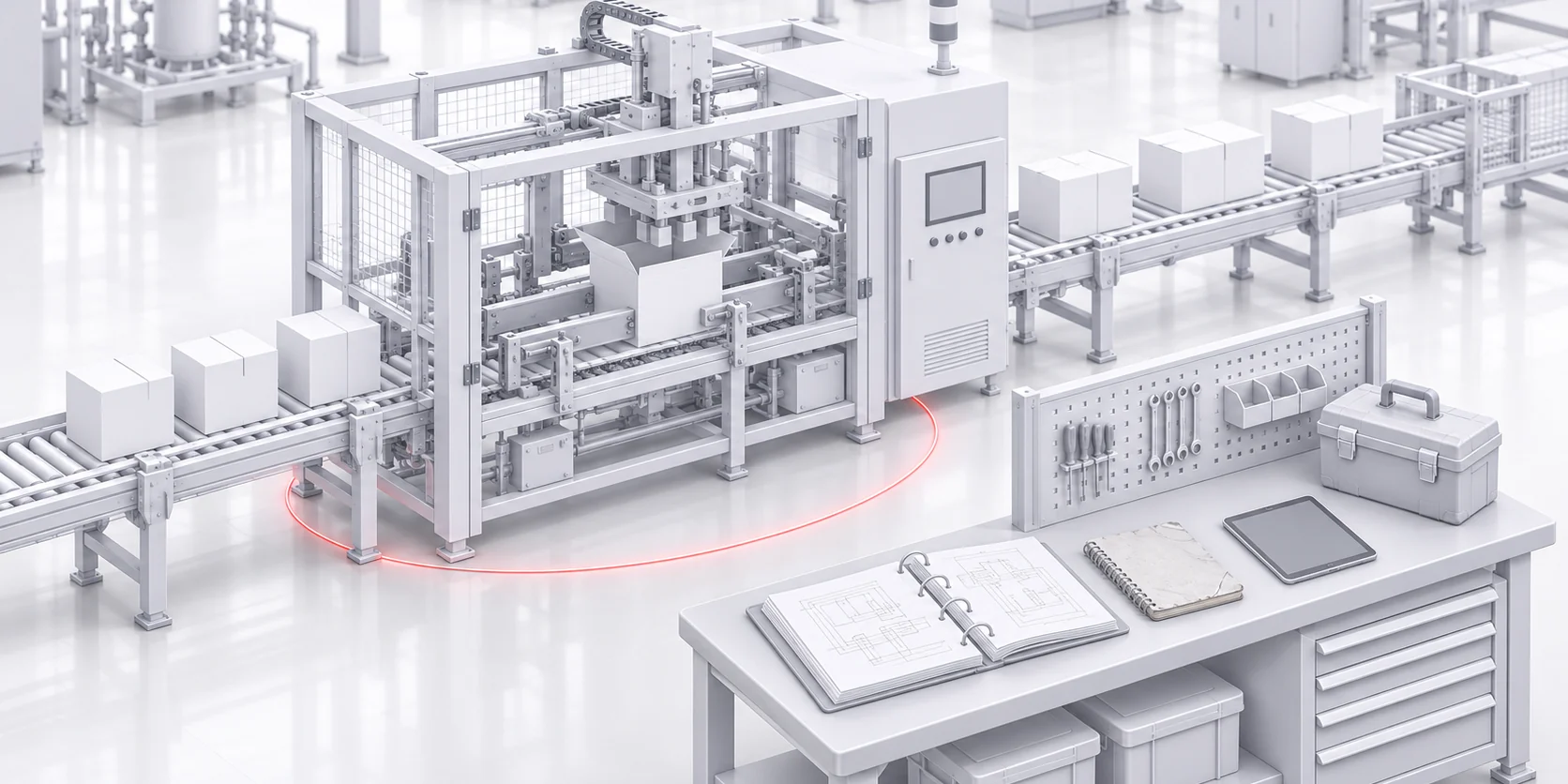
When the case packer throws its jam alarm, a new technician checks the sensor the alarm names. Someone who has worked on that line for twenty years walks straight past it to the side guides, because that’s where the problem has been every time since the format change. Nobody ever wrote that down. When that person retires, it leaves with them, along with their coffee mug and the drawer full of spare fuses nobody else knows about.
Tribal knowledge is what experienced people know about a plant and its machines that isn’t written down anywhere usable: which fault really sits behind an alarm, which drawing is out of date, what was changed in the PLC program after the last breakdown. In maintenance it decides how fast a stop gets fixed, and it walks out of the plant with every technician who retires or moves on. Keeping it means capturing it during the daily work and making the records findable when the next stop happens.
What is tribal knowledge?
The quality-management site iSixSigma defines tribal knowledge as “any information pertaining to a product or service process that resides only in the minds of the employees” (iSixSigma). It’s the practical, site-specific side of what the philosopher Michael Polanyi called tacit knowledge, summed up in his line “we can know more than we can tell” (The Tacit Dimension, 1966, p. 4; University of Chicago Press reprint, 2009). Anyone who has tried to explain over the phone how to free a stuck pusher knows exactly what he meant.
The term itself is workplace jargon. Undocumented know-how means much the same. Institutional knowledge is wider: everything an organization knows, written down or not.
What tribal knowledge looks like in a maintenance team
Every plant has its own list. In a maintenance team, it sounds like this:
- Alarms: the jam alarm on the case packer usually means the side guides, not the sensor it names.
- Drawings: the cabinet was rewired in 2019 and page 23 was never updated.
- The program: an integrator changed a timer after the last breakdown, and only one technician knows why.
- Parts: the replacement sensor from the second supplier needs a different setting.
- History: the same fault came back three times last winter, and what finally fixed it.
Some of this is written down somewhere in your plant, in a shift log, a ticket’s closing comment or an email thread. Very little of it can be found by the person on the night shift when the line stops. We wrote a short piece on exactly that: why the plant forgets.
Why the risk is growing
In the US, the Bureau of Labor Statistics projects about 51,900 openings a year for industrial machinery mechanics, machinery maintenance workers and millwrights from 2025 to 2035 (BLS). Most of them replace people who leave: about 44,000 of the roughly 52,000 openings a year come from workers who leave the labor force, for retirement or other reasons, or move to another occupation (BLS). Moves are the larger group, and they include mechanics promoted to supervisor or planner, who may stay in the plant but don’t work on the machines any more.
The trade is also older than the workforce as a whole. In 2025 the median age of industrial and refractory machinery mechanics was 45.5, against 42.1 for all employed people. 27.7% were 55 or older, and only 5.5% were under 25 (BLS, Current Population Survey).
Where the openings come from, a year
- Moving to other occupations, promotions included23,900
- Leaving the workforce, retirement included20,100
- New jobs from growth8,000
About 85% of the openings replace people who leave the occupation.
Age of the people working, 2025
Industrial and refractory machinery mechanicsmedian age 45.5
5.5% under 2527.7% aged 55+
All employed peoplemedian age 42.1
12.2% under 2523.2% aged 55+
Sources: US Bureau of Labor Statistics, Employment Projections 2025 to 2035, Table 1.10 (industrial machinery mechanics, machinery maintenance workers and millwrights; rounded), and Current Population Survey 2025, Table 11b (industrial and refractory machinery mechanics).
Across US manufacturing, Deloitte and The Manufacturing Institute estimate a need for around 3.8 million employees between 2024 and 2033, of which around half, 1.9 million, could remain unfilled. They put 2.8 million of the 3.8 million down to retirements (Deloitte and The Manufacturing Institute, 2024).
In Europe the issue is a shortage of people more than their age. In 2025, 16 of 28 countries reporting to the EU’s EURES network listed agricultural and industrial machinery mechanics as a shortage occupation, and 17 listed electrical mechanics and fitters. In the same report’s 2024 data, 23.1% of machinery mechanics in these countries were under 30, against 17.3% across all occupations (European Labour Authority, 2025). Czechia, with the EU’s highest share of jobs in manufacturing at 24%, was the only reporting country where both the labor force and employment fell from 2021 to 2024 (Eurostat, European Labour Authority).
What happens when tribal knowledge leaves
In a five-year study in an Australian government department with an aging engineering workforce, the 118 respondents reported that losing knowledge lowered productivity and work quality, made new people take longer to become competent and slowed the work down. The author concluded that the gap was “unlikely to be filled over time” (Journal of Knowledge Management, 2018). At the South Ukraine nuclear power plant, the departments where knowledge loss was most urgent were instrumentation and control, electrical, and maintenance, with “a significant number of key experts on specific technical systems and a lack of clear procedures” (IAEA, 2017).
On the shop floor, it shows up as longer stops and repeat failures. The person on shift starts from the drawings and the manual instead of from what fixed the same fault last time, so your MTTR goes up, and a quick fix that hides the cause brings the fault back. On the case packer, the new technician spends the first half hour on a sensor that was never the problem. An out-of-date drawing is also a safety risk: an isolation that follows it can miss a supply that was added later.
Where tribal knowledge hides in the records
Your plant probably records more than you think, just in a form that’s hard to use. Researchers who cleaned up historical work orders for reliability analysis found the fields for location, failure mode and action often missing or wrong, and the free-text comments the best place to recover them (Journal of Quality in Maintenance Engineering, 2016). A GE Digital team found the same: the free text “often provides detailed information that is commonly missing such as event type, failure mode, or component” (PHM Society, 2019).
Records are also kept in a hurry. In ten years of HVAC work orders at one site, NIST researchers found that about 93% were closed on a Friday, although they were opened evenly across the week, so the close-out dates said little about when the work actually ended (NIST, 2021). Anyone who has cleared a backlog of tickets before the weekend will recognize that.
How to capture tribal knowledge in maintenance
Find where the risk is
Start with whose knowledge you can least afford to lose. The IAEA’s method, used at the Tennessee Valley Authority’s nuclear plants, rates each person on two things: how soon they’re likely to leave, and how critical and unique their knowledge is. Multiply the two, and the highest scores call for “on the job training or shadowing with incumbent” straight away (IAEA, 2017). The same guide warns against rating people by performance, because high performers don’t always hold the unique knowledge. Shadowing only works if the successor starts before the expert leaves, which means approving the position months ahead. Build the ratings with HR from announced plans, because asking employees directly about retirement can raise age discrimination concerns.
Capture it during the daily work
The IAEA lists the post-job briefing among its methods: a short debrief right after a job “to capture lessons learned, skills and knowledge while fresh in an employee’s mind”. In maintenance, that’s a closing comment on every repair that says what was found and what fixed it. For the case packer, it’s one line on the ticket: jam alarm, side guides still set for the old format, reset to the marks.
It works when the comment has a fixed form, such as symptom, cause and action, and a supervisor checks it. At one company in the GE Digital study, regular tracking raised the share of work orders with costs filled in from about 20% to over 90% within three years. Debriefs work in general too: a meta-analysis of 46 samples found they improve individual and team performance by roughly 20% to 25% (Human Factors, 2013), although none of the samples came from maintenance.
Big codification projects are another story. A 2026 case study describes a manufacturer’s 15-year effort to write down the knowledge of its long-serving employees, after which “many of the management team concluded that perhaps the effort to codify tacit knowledge was greater than any realized benefit” (Engineering Management Journal, 2026).
Write down the repeat jobs
One-point lessons from total productive maintenance, a single page on one topic that a team member writes and every shift reads, and standard work for the most frequent faults turn the routine part of an expert’s knowledge into something anyone can follow. For faults that keep coming back, a root cause analysis is the place to write down why, so the fix outlives the shift.
Record every change
Two of the examples above, the rewired cabinet and the changed timer, are changes nobody recorded. You can close that gap with one rule: every PLC change is saved with a short reason, in the project file or in version management software, and every wiring change is marked up on the drawing and carried into the as-built set. That keeps the reason with the change, and it makes the “what changed?” step in PLC troubleshooting and in reading the schematics actually possible.
Pair people up
Shadowing and supervised work pass on the parts that can’t be written down, which is why the IAEA prescribes them for the highest-risk roles. Their weakness, as the same guide notes, is that “knowledge is not captured in a sustainable and accessible format”, so they need a written record next to them.
Make the records findable
A record only helps if the next person can find it during a stop, at the machine, on the night shift. That means searchable journals and tickets, linked to the machine, and readable in the language your technicians use.
AI assistants and the knowledge in the records
Two studies suggest that assistants built on an organization’s own records help the least experienced people most. In a field experiment at a train manufacturer, 19 commissioning technicians worked through 173 troubleshooting tasks. Those using an assistant that answered from company documents, with links to the source paragraphs, scored 2.69 on average on a 1 to 5 scale against 1.43 without it, and technicians with under three years’ experience gained the most (International Journal of Production Research, 2025). It was a small study, run on prepared scenarios outside live production.
In customer support, an AI assistant trained on a firm’s past conversations raised the number of issues resolved per hour by 15% on average and by about 30% for less experienced agents. Agents with two months on the job performed like those with more than six months who worked without it (Quarterly Journal of Economics, 2025). For the wider picture, see AI in manufacturing.
Where Edmund fits
Edmund reads what your plant already has: the maintenance journals and shift logs, handwritten notes included, together with the PLC programs, the electrical drawings and the manuals. When a line stops, a technician asks in plain language and gets the likely cause with the source of each finding, including the journal entry where someone fixed the same fault before. So the new technician on the case packer gets pointed to the side guides, with the ticket that proves it. “AI is the only tool that can systematically work with data from multiple sources,” says David Frajt, head of maintenance at Moravia Cans. If your plant has a twenty-year veteran nobody can replace, talk to us before they retire.
Frequently asked questions
What is tribal knowledge?
Knowledge about a process, a plant or its machines that lives only in employees’ heads and isn’t documented in a usable form.
What is another word for tribal knowledge?
Undocumented know-how is the closest. Institutional knowledge and tacit knowledge are related, wider terms.
What is the difference between tribal knowledge and institutional knowledge?
Institutional knowledge usually means everything an organization knows, written down or not. Tribal knowledge is the part that sits in people’s heads, or in records nobody can find during a stop.
Why is tribal knowledge a risk in maintenance?
Because it leaves with the people who hold it, and in maintenance it decides how fast a stop gets diagnosed. Most openings in the trade replace people who retire or move to other occupations.
How do you capture tribal knowledge?
Find the people and roles where the risk is highest, record what was found and fixed after every repair, write one-point lessons and standard work for repeat jobs, pair new technicians with experienced ones, and keep the records searchable by machine and symptom.