


MTTR in maintenance: meaning, formula and how to reduce it
A 90-minute stop, and only ten of those minutes went on the repair. What MTTR means, how to calculate it, where the minutes go and how to bring it down.
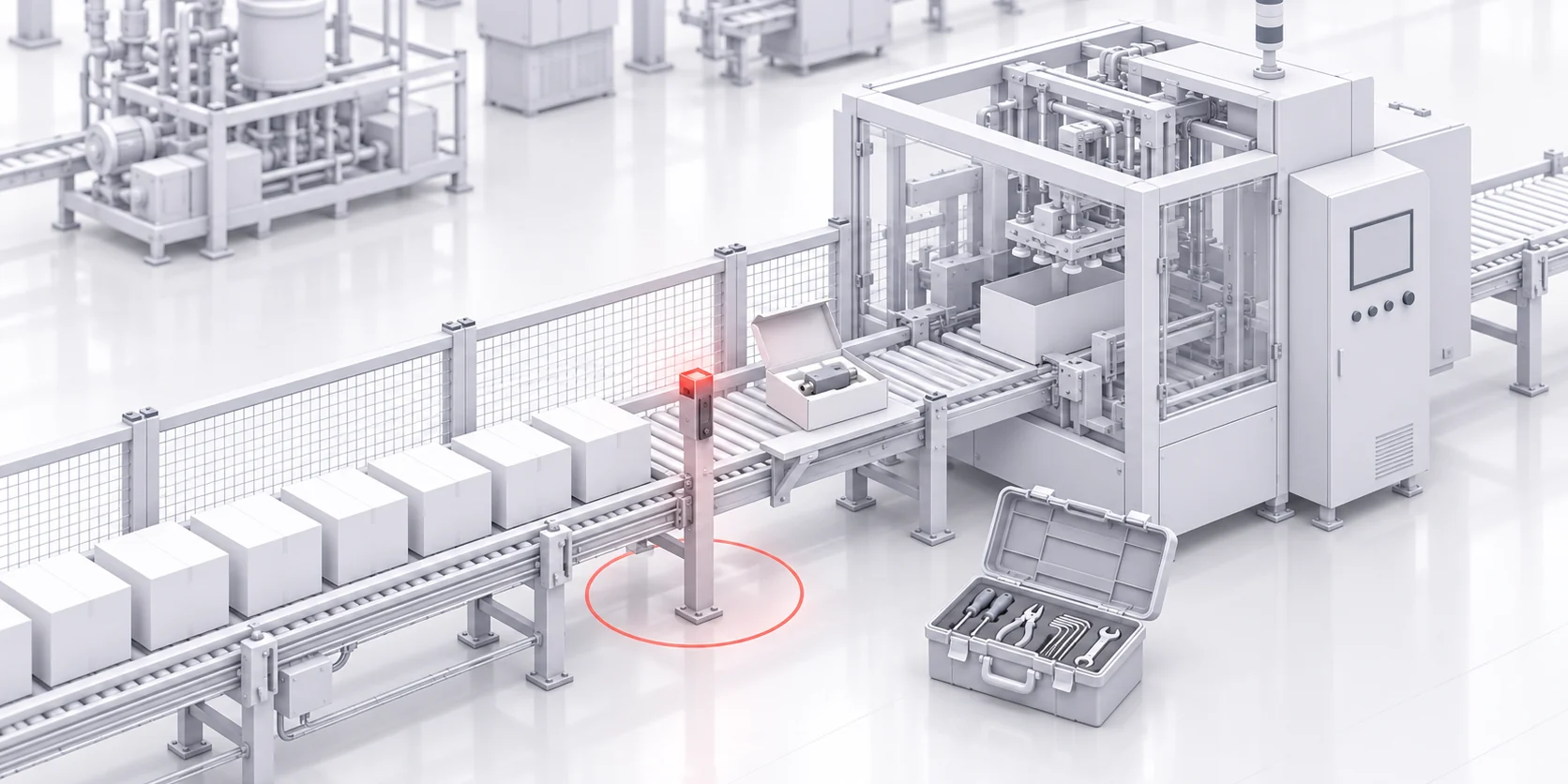
A case packer stops at ten past two in the afternoon. The HMI shows a fault code, the operator calls maintenance, and the technician gets there fifteen minutes later from the other end of the plant.
The code points to a whole station, not a device, so the search starts. They open the drawings and test the sensors one by one, and at five past three they find it: a proximity sensor on the infeed that no longer switches. There’s a spare in the stores, which takes another quarter of an hour to fetch. Ten minutes to fit and adjust it, ten more to test, and at twenty to four the first good cases come off the line.
That stop counts as 90 minutes in this month’s MTTR, and only ten of them went on swapping the sensor.
What does MTTR mean in maintenance?
MTTR, or mean time to repair, is the average time it takes to get a failed machine running again. Add up the repair time of every stop like the one above over a month, divide it by the number of stops, and you have your MTTR. It shows how quickly your team gets equipment back into production after a breakdown.
You’ll also see it called mean time to restoration, which is the name the international standard uses (IEC Electropedia). Most maintenance teams still say repair, and both mean the same number. In IT, the same four letters usually stand for mean time to resolve an incident, which is why some search results for MTTR are about servers.
Plant managers look at MTTR to see how long breakdowns hold up production. Maintenance leads look at it to see where their team loses time.
MTTR formula
The formula divides the time spent on corrective repairs by the number of repairs in the same period:
MTTR = total repair time / number of repairs
Express it in minutes or hours, and use the same period and the same equipment for both numbers: one machine, one machine family or one line, over a week, a month or a quarter.
How to calculate MTTR
Say your packaging line had 12 unplanned stops last month, and the repairs took 18 hours altogether.
- Total repair time: 18 hours.
- Number of repairs: 12.
- MTTR = 18 / 12 = 1.5 hours, or 90 minutes.
In Excel, put one repair per row with its duration in minutes, then divide the sum of the durations by the number of rows. Do it per machine or machine family as well as per line. A single ten-hour stop can move a monthly average a long way, so put the median next to the mean, or the next review will go on explaining a number that one bad night produced.
- Running, 480 h
- Stopped, 12 times, 18 h
MTTR would be 1.1 h and availability 97.3%, with the same 12 failures.
* A simplified model. Real MTTR and availability figures take more inputs than these, such as when the clock starts and stops, which delays count, and planned downtime.
When the MTTR clock starts and stops
MTTR numbers only compare when everyone measures them the same way, and reliability people happily argue about details such as whether the technician’s walk to the machine counts. Write your rules down before you compare lines or plants:
- Start: when the machine stops, when the alarm is raised, or when maintenance is called.
- Stop: when the machine runs again, when the first good part comes off the line, or when production accepts the machine back.
- Delays: whether waiting for a part, a permit or an outside technician counts toward MTTR or gets reported separately.
For the case packer, the clock ran from the stop at ten past two to the first good cases at twenty to four.
The six phases of a repair
Every repair goes through the same phases, whether it takes ten minutes or ten hours:
- Detect. Someone notices the stop and reports it.
- Wait. For the right person, a lockout, a permit or a part.
- Localize. Find the station, module or component at fault.
- Diagnose. Find out why it failed.
- Correct. Fix or replace it.
- Check out. Test, restart and confirm good production.
Machine stops
Running again
Diagnosis varies most with who is on shift. In a field experiment at ETH Zurich, the less experienced technicians gained the most from an AI assistant built on the project's documents.
You’ll find percentages online for how MTTR splits across these phases. We haven’t found one with a credible published source behind it; they trace back to vendor pages. Log the time at each phase for a month of stops and you’ll have your own split, and that’s the one that matters for your plant.
Diagnosis is the phase that changes most with who’s on shift. In a field experiment at ETH Zurich, technicians commissioning trains did significantly better with an AI assistant built on the project’s documents than without one, and the least experienced technicians gained the most (International Journal of Production Research, 2025). That gap between experienced and new technicians is tribal knowledge at work, and it shows up directly in your MTTR.
MTTR vs MTBF vs MTTF
The three get mixed up all the time:
- MTTR (mean time to repair) is how long it takes to get a failed machine running again.
- MTBF (mean time between failures) is how long a repairable machine runs between failures: the operating time divided by the number of failures.
- MTTF (mean time to failure) is the same idea for parts you replace instead of repairing, such as a sensor or a fuse.
MTBF tells you how often a machine fails, and MTTR how long each failure lasts. Together they set availability:
availability = MTBF / (MTBF + MTTR)
A machine with an MTBF of 40 hours and an MTTR of 1.5 hours is available 96.4% of the time. Bring MTTR down to 1.1 hours and it’s available 97.3% of the time, with exactly as many failures as before. Preventive maintenance and root cause analysis raise MTBF. Faster diagnosis and repair lower MTTR.
A machine that is repaired
A part that is replaced
What is a good MTTR?
Lower is better, but there’s no universal benchmark to aim for. Twenty minutes is slow for a conveyor and fast for a robot cell with a vision system. Set targets per machine family, compare the same machines across lines and plants, and watch the trend more than the single number.
For context, Siemens reported in its 2024 survey of manufacturers that the time needed to restart production after a failure had grown from 49 minutes in 2019 to 81 minutes. It linked the rise to lost skilled labor, slower spare-part supply and more complex faults (Siemens, 2024).
Why MTTR matters
Every minute of MTTR is a minute your line isn’t producing. Downtime hours are the number of stops multiplied by MTTR, so MTTR drives the cost of downtime directly, and it feeds the availability part of OEE. Our guide to what an hour of downtime costs shows how to put a price on those hours.
How to reduce MTTR in maintenance
Go back to the case packer for a moment. Of its 90 minutes, ten went on the repair itself, and most of the ideas below go after the other 80:
- Make alarms specific. An HMI message that names the device and where it is, like “Infeed sensor B3 not switching”, saves the first minutes of every stop. On the case packer it would have saved most of the search.
- Put the documents at the machine. The PLC program, the electrical drawings and the manuals should open on a phone or tablet at the line, instead of in a cabinet at the other end of the plant. A QR code on each machine helps.
- Keep the fault history searchable. Every closed ticket should say what was found and what fixed it, so the next technician can search by machine and symptom instead of starting from zero. Most plants lose this without noticing, which is the story of why the plant forgets.
- Write standard work for your ten most frequent faults. A short troubleshooting guide per fault takes the guesswork out of a night shift.
- Stock what failed before. Record the part number in every ticket and check stock for anything that fails repeatedly.
- Agree when to escalate. Decide when a technician calls the expert or the machine builder, so nobody spends two hours alone on a fault that needs a five-minute call.
- Train on real faults. Let less experienced technicians shadow repairs and walk through past stops.
- Measure the phases. Log the time spent detecting, waiting, localizing, diagnosing, correcting and checking, and go through the longest stops every week.
- Give technicians an AI assistant for diagnosis. One that reads your own PLC programs, drawings and maintenance records shortens the diagnosis, especially for less experienced staff. More in how AI reduces machine downtime.
Faults that keep coming back are a reliability problem more than an MTTR problem. A root cause analysis stops them returning and raises MTBF.
MTTR as a maintenance KPI
If MTTR goes on your monthly report, a few habits keep it honest:
- Report it per machine family, next to MTBF, as a monthly trend.
- Show the median as well as the mean, and list the three longest stops.
- Split it by phase once you have the data, so you know which lever to pull.
- Check the data. Tickets opened late or closed in bulk distort MTTR more than anything else.
At Amcor Flexibles, Edmund made fault diagnosis 90% faster and repairs 26% shorter. The gap between the two numbers is the rest of the repair: the waiting, the fix and the restart, which a faster diagnosis doesn’t shorten. To see what a lower MTTR would mean for your plant, try the savings calculator.
Frequently asked questions
What does MTTR stand for?
MTTR stands for mean time to repair. The international standard calls it mean time to restoration. In IT it usually means mean time to resolve or recover from an incident.
Is a high or low MTTR better?
Low. It means failed machines are back in production sooner. A rising MTTR is an early sign of missing skills, spare parts or documentation.
How do you calculate MTTR and MTBF?
MTTR is the total repair time divided by the number of repairs. MTBF is the total operating time divided by the number of failures. Use the same machine and the same period for both.
What is the difference between MTTR and MTTF?
MTTR measures how long a repair takes. MTTF, mean time to failure, measures how long a non-repairable part works before it fails and gets replaced.
Does MTTR include waiting for parts?
It depends on your definition. The international standard counts waiting for parts separately from repair time. Decide whether your MTTR includes it, and report the waiting time on its own either way.