


Types of maintenance: 5 strategies and when to use each
One packaging line can run all five types of maintenance at once. What each one is, what triggers the work, and how to pick the right one for each failure.
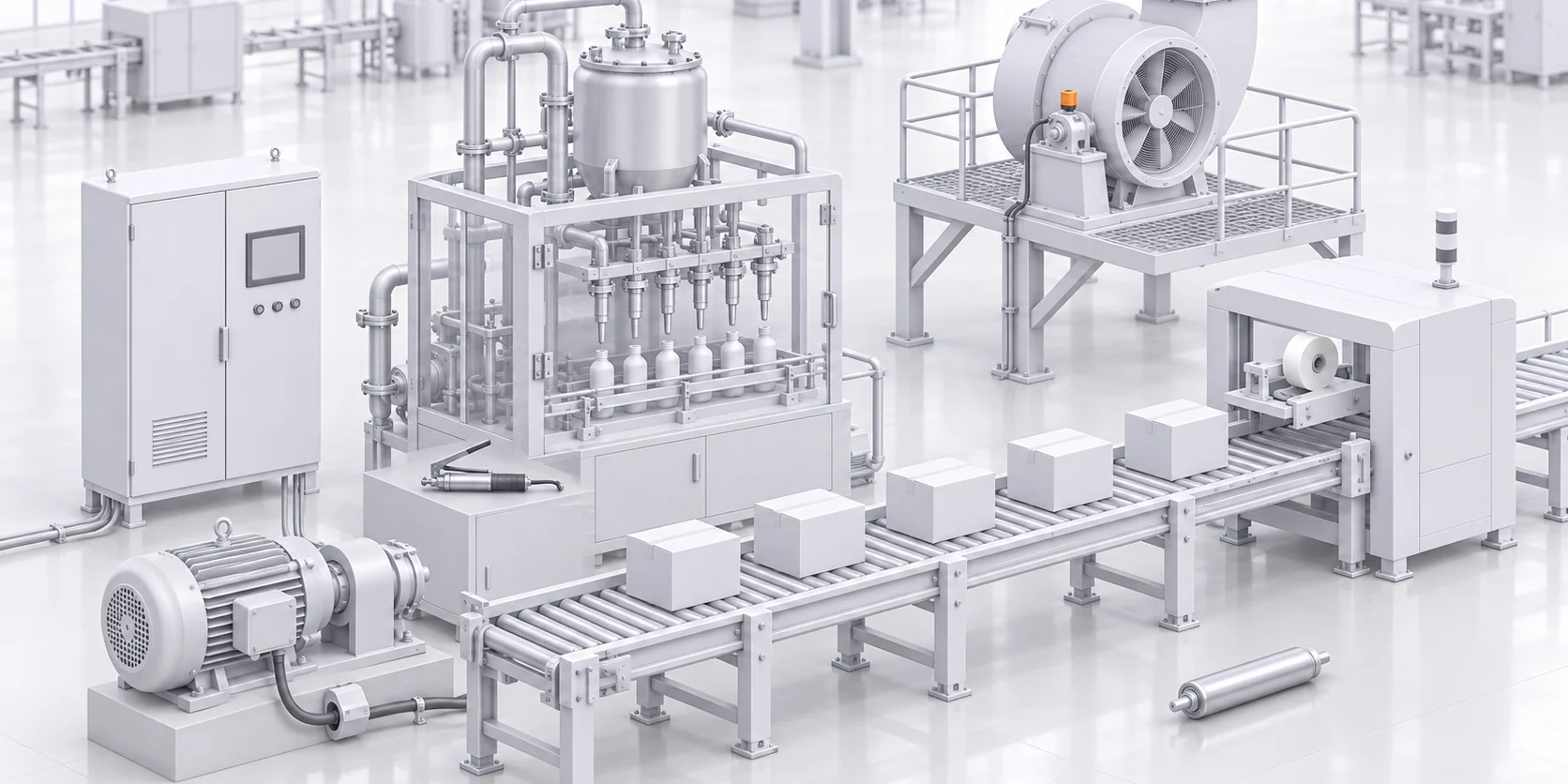
Spend a week in a packaging plant and you’ll probably see every type of maintenance, sometimes on the same line. The conveyor rollers get replaced when they fail. The filler gets its lubrication on a fixed schedule. A technician walks a vibration route on the exhaust fans every two weeks. A model watches the main drive’s motor current and estimates when its bearing will need changing. And in a few plants, a system also suggests which of those jobs to do in Saturday’s stop.
Nobody in that plant would call it a strategy. It’s just how each machine ended up being looked after.
Maintenance is usually sorted into five types: reactive, preventive, condition-based, predictive and prescriptive maintenance. They differ in what triggers the work: the failure itself, a fixed interval, a measured condition, a forecast, or a recommendation. Most plants use several of them, chosen per asset and per failure, depending on what the failure costs and whether it gives any warning.
The five types of maintenance at a glance
- Reactive maintenance: repair after the failure.
- Preventive maintenance: service or replace at fixed intervals of time, cycles or output.
- Condition-based maintenance: act when a measured condition crosses a limit.
- Predictive maintenance: forecast the failure from condition trends and plan the repair.
- Prescriptive maintenance: recommend the action, its timing and its trade-off.
-
ReactiveRepair after the asset breaks.
-
PreventiveWork at fixed intervals of time, cycles or running hours.
-
Condition-basedWork when a measured condition crosses a limit.
-
PredictivePlan the repair from a forecast of the failure.
-
PrescriptiveA recommended action, with its timing and its trade-off.
More data and more trust in the model
Each step needs more data and more trust in the model than the one before, and none of them is right for every asset.
Why every list looks different
If you’ve read three articles on this and found three different lists, you’re not imagining it. The European standard EN 13306 splits all maintenance into two: corrective, after a fault is found, and preventive, before it. Predictive maintenance sits inside preventive as a kind of condition-based maintenance. Prescriptive maintenance isn’t in any standard at all; it comes from research and vendors. And plenty of sources treat condition-based and predictive maintenance as one type.
In this post, preventive maintenance means the time-based kind, which EN 13306 calls predetermined maintenance.
Reactive maintenance
The equipment runs until it fails, then it’s repaired, like the conveyor rollers. As a deliberate choice, called run to failure, it fits items whose failure is cheap, safe and doesn’t stop production. As the default for critical equipment, it’s expensive, because the failure picks the time. More in what is reactive maintenance.
Preventive maintenance
Work is done at fixed intervals, whatever the equipment’s condition: every 2,000 operating hours, every 500,000 cycles, every quarter. It suits parts that wear with use at a fairly predictable age and are hard to check, such as cutting tools changed on a stroke counter, and routine servicing like lubrication.
The risk is that you do work that wasn’t needed and break something while doing it. The US Department of Energy’s maintenance guide lists both, the “performance of unneeded maintenance” and the “potential for incidental damage to components in conducting unneeded maintenance” (DOE FEMP). NASA goes further: in many cases “scheduled overhaul increases the overall failure rate by introducing a high infant mortality rate into an otherwise stable system” (NASA). Anyone who has chased a fault that appeared right after a planned overhaul knows the feeling.
Condition-based maintenance
The equipment is inspected or monitored, and the work is triggered by its condition: vibration above a limit, a temperature rise, wear measured with a gauge. The condition can come from an operator’s eyes and ears, a scheduled inspection or a permanently installed sensor. It suits failures that give a measurable warning, such as bearing wear, misalignment or a clogging filter. The vibration route on the exhaust fans is the classic example.
Predictive maintenance
Predictive maintenance goes a step further. It follows the condition data over time and forecasts when the failure will happen, so the repair can go into a planned stop. You need condition data, from sensors or regular readings, and a way to project the trend, from an experienced analyst to a statistical model. Models trained on data also need a history of failures. It works best on wear failures with a long warning, like the bearing in that main drive. More in what is predictive maintenance.
Prescriptive maintenance
Prescriptive maintenance adds the decision: which task, in which planned stop, with which parts, and what it costs to wait. It’s the newest of the five, and the least common in real plants. More in what is prescriptive maintenance.
Corrective, planned and proactive maintenance
You’ll also run into three terms that describe groups of the types above rather than types of their own:
- Corrective maintenance is any work after a fault is found, done right away or deferred. Reactive maintenance is corrective work done as a strategy.
- Planned maintenance is any work prepared and scheduled in advance.
- Proactive maintenance removes the causes of failures, through root cause analysis and design changes, instead of responding to them.
How to choose the right type of maintenance
You choose per failure mode, not per plant or even per machine. Reliability-centered maintenance gives you the method, and SAE JA1011 sets out what it has to ask (SAE). For each way a machine can fail, you go through four questions: would anyone notice the failure, what does it cost, does it give a warning you can catch in time, and does it depend on age? The figure follows the same logic, simplified.
The first question catches what the others miss. Some devices only matter when something else fails, like a standby pump or a high-level switch. Their failure stays hidden until the day you need them, so you test them at set intervals to make sure they still work.
-
Would someone notice the failure when it happens, in normal operation?
-
Could the failure hurt someone or harm the environment?
-
Would it stop or slow production, or cost more to repair than a check would cost?
-
Does it give a measurable warning early enough to plan the repair, and can you check for it often enough?
-
Is there enough condition data and failure history to forecast when it will fail?
-
Does it wear out with running time, cycles or output, at a fairly predictable age?
A hidden failure shows only when the device is needed. Test it at a set interval to find out whether it still works, or change the design so the failure shows.
Example: a standby pump or a high-level switch.No check or scheduled task costs less than the repairs it avoids, and the failure is safe. Keep a spare and repair it when it breaks.
Example: the light inside a control cabinet.Watch the warning and act when it crosses a limit you set. Inspect often enough to catch the change before the failure.
Example: a gearbox with vibration readings every two weeks.Model the condition trend to forecast the failure and plan the repair into a stop. With costs and stock in the model, it can recommend the action as well.
Example: a critical pump with continuous vibration and temperature data.Replace or restore it at a fixed interval of time, cycles or output, before the age at which it usually fails.
Example: a cutting knife changed on a stroke counter.A failure that can hurt someone, gives no warning and does not depend on age needs a change to the design, such as guarding, a different part or redundancy.
Example: a hydraulic hose next to the operator that can burst without warning.No routine task prevents a failure that gives no warning and does not depend on age. Change the design or add redundancy, or make sure the next stop is diagnosed in minutes.
Example: a proximity sensor or an electronic card that fails at random.Simplified from the decision logic of reliability-centered maintenance (SAE JA1011), which treats condition-based and predictive tasks as one choice. The question about data is our addition.
Age is the question people get wrong most often. In the 1978 United Airlines study that started reliability-centered maintenance, only 4% of the aircraft components examined followed the classic bathtub curve, and 89% showed no wear-out age at all, so replacing them on a schedule couldn’t make them more reliable (Nowlan and Heap). NASA’s guide compares three such studies of aircraft and naval equipment, in which 77% to 92% of the items showed no wear-out age (NASA).
Factory machines weren’t part of those studies, but the logic is the same on your line. A calendar can only prevent failures that depend on age, and a sensor can only predict failures that give a warning.
What the mix looks like in practice
- US manufacturers in a NIST survey estimated that 45.7% of their 2016 machinery maintenance and repair spending went to reactive work, 31.8% to preventive and 17.3% to predictive maintenance (NIST, 2020).
- In Plant Engineering’s 2020 maintenance study, 76% of respondents had preventive maintenance in place, 60% ran at least some equipment to failure and 41% had predictive maintenance with analytical tools. Most use several at once (Plant Engineering and ATS).
Whatever your mix, some failures will still happen without warning, so the speed of the repair matters. How long a stop lasts is your MTTR, and how often stops happen is your MTBF.
Where Edmund fits
Most lists of maintenance types skip one step: finding out why something failed. That’s where Edmund works. When a sensor fails at random, a card dies or a jam stops the line, a technician asks in plain language, and Edmund answers from the plant’s PLC programs, electrical drawings, manuals and maintenance journals, with the source for each finding. It doesn’t predict failures. It shortens the search for the cause once one has happened. At Amcor Flexibles, fault diagnosis got 90% faster and repairs got 26% shorter. If you have a fault your team keeps chasing, send it to us.
Frequently asked questions
What are the main types of maintenance?
Reactive, preventive, condition-based, predictive and prescriptive maintenance. Corrective, planned and proactive maintenance are umbrella terms for groups of them.
What is the difference between preventive and predictive maintenance?
Preventive maintenance works at fixed intervals, whatever the condition. Predictive maintenance monitors the condition and forecasts the failure, so the work is done when it’s needed.
What is the difference between condition-based and predictive maintenance?
Many sources use the two terms for the same practice. Where they’re told apart, condition-based maintenance acts when a measurement crosses a limit, and predictive maintenance follows the trend to forecast when that will happen.
Which type of maintenance is best?
None on its own. The right type depends on the failure: whether anyone would notice it, what it costs, whether it gives a warning, and whether it depends on age. Most plants use a mix.
What is the most common type of maintenance?
Preventive maintenance is the most widely used: 76% of respondents in Plant Engineering’s 2020 study had it in place. Measured by spending, reactive work is still the biggest share, at 45.7% of machinery maintenance and repair costs in NIST’s survey of US manufacturers.