


What is predictive maintenance and what can't it predict?
A worn bearing usually warns you weeks before it fails. Predictive maintenance is how you catch that warning. How it works, what you need for it, and the failures it can't see coming.
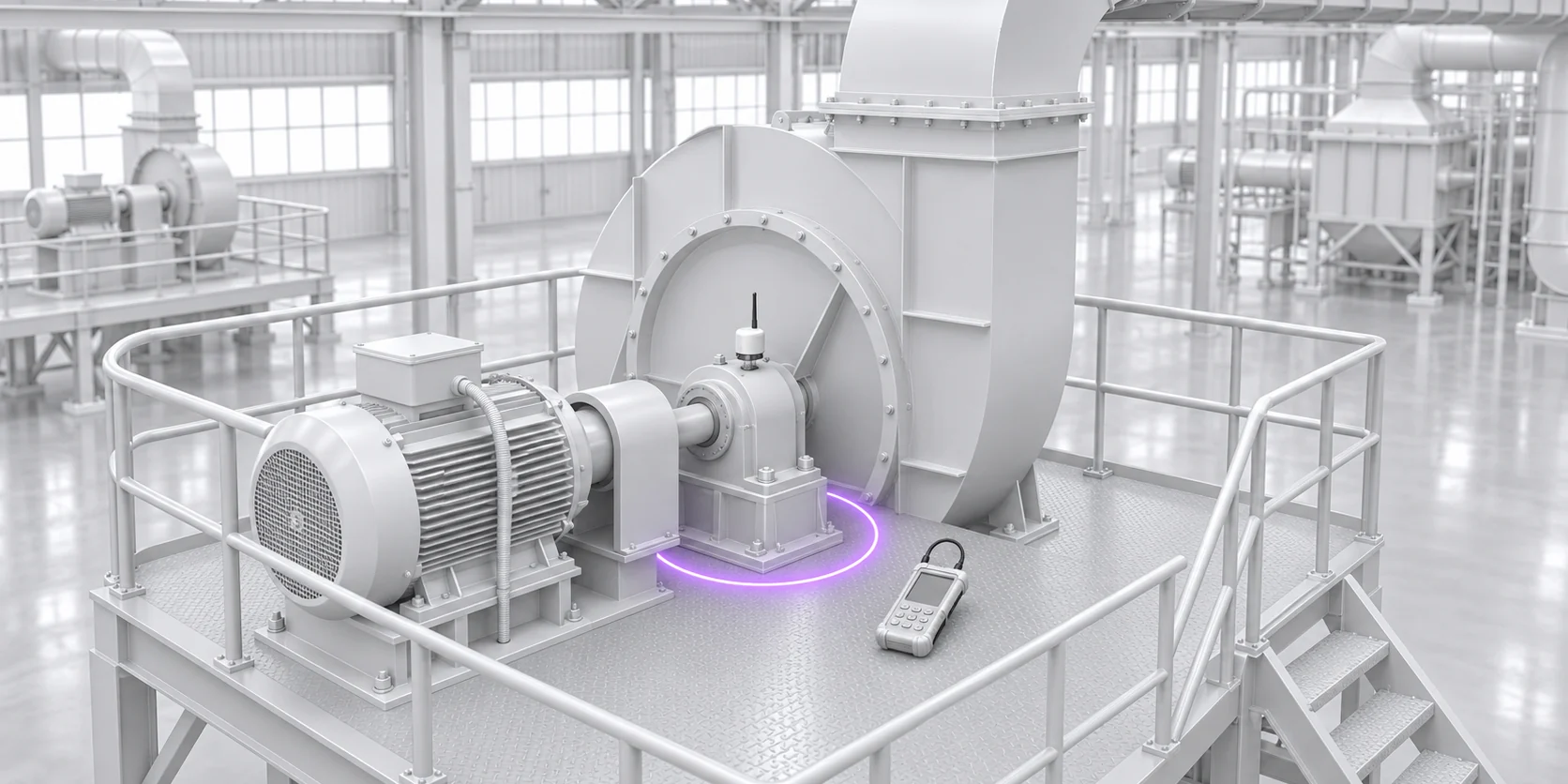
The bearing in the main exhaust fan starts to go in March. Nobody can hear it yet, but on the two-weekly vibration route the reading creeps up a little every time. In May it crosses the alert limit, the bearing goes into the plan for the Saturday stop, and on Saturday it comes out with a pitted outer race. Without the route, the first sign would have been a seized fan in the middle of a shift, with half the line standing around waiting for it.
That’s predictive maintenance on a good day: a part that wears out slowly and tells you about it weeks in advance.
Predictive maintenance uses condition data from a machine, such as vibration, oil analysis, temperature or motor current, to forecast when a part will fail, so you can repair it at a time you choose. It works on parts that wear and give a measurable warning, like bearings, gearboxes and pumps. It can’t forecast failures that come without any warning, and on an automated line, many sensor, electronic and control faults do exactly that.
How predictive maintenance works
Take the software away and it comes down to five steps. The exhaust fan went through all of them:
- Measure. Fixed sensors, or a technician on a route with a handheld, collect vibration, oil samples, temperature, current or process data.
- Spot the change. You compare the readings with the machine’s normal behavior. The fan’s March reading was only a little higher than usual, but it was higher.
- Forecast. A model or an analyst estimates how long the part has left.
- Plan the repair. The job goes into a planned stop, with the part on the shelf and the people booked. Deciding which stop and which part is the step prescriptive maintenance tries to automate.
- Learn. What you find when the part comes out, like that pitted outer race, goes back into the model. A short root cause analysis is the habit that makes this step actually happen.
The P-F curve
Everything in predictive maintenance hangs on one picture. P is the point where a developing failure first becomes detectable. F is the functional failure, when the machine can no longer do its job. The time between them is the P-F interval (SAE JA1011).
For the fan, P was that first creeping reading in March, and F would have been the seized fan. The weeks in between are what turned a breakdown into a planned Saturday job.
Typical warnings, earliest first
- Oil analysis
- Ultrasound
- Vibration analysis
- Thermography
- Audible noise
- Hot to the touch
A wearing gearbox bearing gives several warnings as it degrades. Methods that pick up small changes, such as oil analysis, ultrasound and vibration, see it early; heat and noise come late, close to the failure. The earlier the warning is caught, the more time there is to plan the repair into a stop.
A sensor or an electronic card often fails with no measurable warning. There is no P-F interval to work with, so the work starts after the stop, and the downtime depends on how fast the cause is found and fixed.
An illustration, not measured. Each method has its own P: the time to plan runs from the point your method can see the change, less the time between checks. Guides differ on the order of the methods, and the intervals differ for every failure mode.
Each way of detecting a failure has its own P. Vibration usually picks up a failing bearing well before you can hear it or feel the heat, so it gives you a longer interval to work with. The rule that follows is simple: you have to check more often than the interval is long, or the failure slips through between two readings. NASA’s maintenance guide even cuts the check interval to a third or a quarter once a reading crosses the alert limit (NASA).
What you need for predictive maintenance
Before anyone sells you sensors, make sure the basics are in place:
- Your critical machines and how they fail. Start with the machines whose stop costs you the most, and the failure modes behind those stops. Then pick the technique that can see each one.
- Condition data on those machines, from fixed sensors or a regular route.
- Failure and repair history, including what you found when the part came out. If that history lives in the heads of your two most senior technicians, you have a tribal knowledge problem to solve first.
- Instruments and skills. The US Department of Energy’s maintenance guide lists the cost of diagnostic equipment and training among the downsides of predictive maintenance (DOE FEMP). Somebody has to be able to read those vibration spectra.
- A way to act: a planned stop, a part and a technician, usually organized through the CMMS. A forecast nobody acts on changes nothing.
Then do the sums. The monitoring has to cost less than the failures it prevents, or, where a failure could hurt someone, bring the risk down to a level you can live with (SAE JA1011).
Predictive maintenance techniques
- Vibration analysis finds bearing wear, imbalance, misalignment and looseness in anything that rotates. It’s the workhorse, and it’s what caught the fan.
- Oil and wear particle analysis finds wear and contamination in gearboxes, hydraulics and engines. More iron in the sample than last time is a gearbox telling you something.
- Ultrasound picks up early bearing wear, compressed-air leaks and electrical discharge.
- Infrared thermography shows hot terminals, overloaded circuits and overheating bearings.
- Motor current analysis reads electrical faults, and some mechanical ones, from the current the motor draws.
- Performance trending watches the pressures, flows, temperatures and cycle times your PLC or SCADA already collects. It’s often the cheapest place to start, because the data is already there.
Predictive maintenance examples
Here’s what it looks like on a typical line:
- The fan bearing: vibration rises over several weeks, and the bearing is replaced at the next planned stop.
- A gearbox: oil analysis shows more iron particles than last time, so the gearbox gets inspected before a tooth breaks.
- A cabinet terminal: a thermography scan shows one terminal much hotter than its neighbors, and it’s remade at the next shutdown, before it burns.
- A pump: motor current and pressure drift as the impeller wears, and the pump is overhauled at the next shutdown.
Predictive vs preventive maintenance
Preventive maintenance changes parts on a calendar, every so many hours or every quarter, whatever their condition. Predictive maintenance still counts as preventive, but it goes by the part’s condition. A bearing that’s still healthy on its scheduled date keeps running, and one that starts to go early gets changed early. Our overview of the types of maintenance puts all five strategies side by side.
Why bother? Because a lot of parts don’t wear out on a schedule. When United Airlines studied its aircraft components in the 1970s, 89% of them showed no wear-out age at all, so changing them on a schedule couldn’t make them more reliable (Nowlan and Heap, 1978). Those were aircraft parts, not factory machines, and simple parts like tires and brake pads did wear out. It’s still a good reason not to trust the calendar blindly.
Swapping a healthy part can even make things worse. NASA notes that “in many cases scheduled overhaul increases the overall failure rate by introducing a high infant mortality rate into an otherwise stable system” (NASA). Anyone who has opened a gearbox that was running fine knows what that means: every time you take a machine apart, something can go back in wrong.
How many plants use predictive maintenance
- In Plant Engineering’s 2020 maintenance study, 41% of respondents had predictive maintenance with analytical tools in place, against 76% with preventive maintenance and 60% who ran at least some equipment to failure (Plant Engineering and ATS).
- In a 2023 PMMI study, 71% of packaging and processing executives said they had some form of predictive maintenance technology in place (Packaging World).
- The money tells a smaller story. US manufacturers in a NIST survey estimated that 17.3% of their 2016 maintenance and repair spending went to predictive maintenance, against 31.8% for preventive work and 45.7% for reactive repairs (NIST, 2020).
So plenty of plants have predictive maintenance somewhere, and close to half of the maintenance money still goes to fixing things after they break.
What predictive maintenance saves
You’ve probably seen the big numbers: ten times the investment back, 70% to 75% fewer breakdowns, 35% to 45% less downtime. Most of them trace back to the US Department of Energy’s O&M Best Practices Guide, which has printed them since 2002 and credits them to unnamed “independent surveys”. Treat them as a marketing promise. Reported results are more modest. A study NASA commissioned in 2000 put the return on its reliability program, predictive testing included, at 1.75 to 2.20 times the investment (NASA). That’s still a good return, at about a fifth of the figure you usually see quoted.
Limits of predictive maintenance
Predictive maintenance needs a warning, and plenty of failures don’t give one.
- Failures without warning. A proximity sensor, a PLC card or a software fault can fail with no measurable change beforehand. There’s no March reading to catch and no P-F interval to work with.
- Not every machine fits. NASA’s guide says predictive testing “does not lend itself to all types of equipment or possible failure modes and therefore should not be the sole type of maintenance practiced”.
- Learning models need failures to learn from, and a well-run plant doesn’t have many failures of the same kind. Trending against alarm limits and the machine’s own baseline works without that history.
- False alarms cost you trust. After the third one, nobody runs to the fan any more. Missed alarms cost you the very failure you bought the system to prevent.
On an automated line, many stops come from that first group: sensors, electronic cards, safety circuits and the control logic. For those, the work starts after the line has stopped, and your downtime depends on how fast someone finds the cause. That time is your MTTR.
AI and predictive maintenance
Machine learning is the usual engine behind anomaly detection and remaining useful life estimates. It doesn’t change the rule above: a model can only forecast a failure that leaves a trace in its data. For the wider picture, read our posts on AI in manufacturing and how AI reduces machine downtime.
Where Edmund fits
Edmund doesn’t predict failures. It works after the stop. When a line goes down, the technician asks in plain language, and Edmund answers from your PLC programs, electrical drawings, manuals and maintenance journals, with the source for every finding. At Amcor Flexibles, fault diagnosis got 90% faster and repairs got 26% shorter.
So keep your vibration route. Edmund is for the night a proximity sensor dies without any warning. If you have a fault like that, send it to us.
Frequently asked questions
What is predictive maintenance in simple terms?
Watching how a machine’s condition changes, and fixing it just before it would fail, at a time you choose.
What is an example of predictive maintenance?
Measuring a fan bearing’s vibration every two weeks, seeing it rise, and replacing the bearing at the next planned stop before it seizes.
What is the difference between predictive and preventive maintenance?
Preventive maintenance works on a fixed schedule. Predictive maintenance works from the measured condition and a forecast of the failure, and the standards count it as a kind of preventive maintenance.
What is the difference between predictive and condition-based maintenance?
Many people use the two terms for the same thing. Where they’re told apart, condition-based maintenance acts when a measurement crosses a limit, and predictive maintenance uses the trend to forecast when that will happen. The European standard EN 13306 treats predictive maintenance as a kind of condition-based maintenance.
Can predictive maintenance prevent all failures?
No. It needs a measurable warning and enough time to act on it, and many electronic and control failures, and some electrical ones, give none.